API Gateway: More Than Just Routing
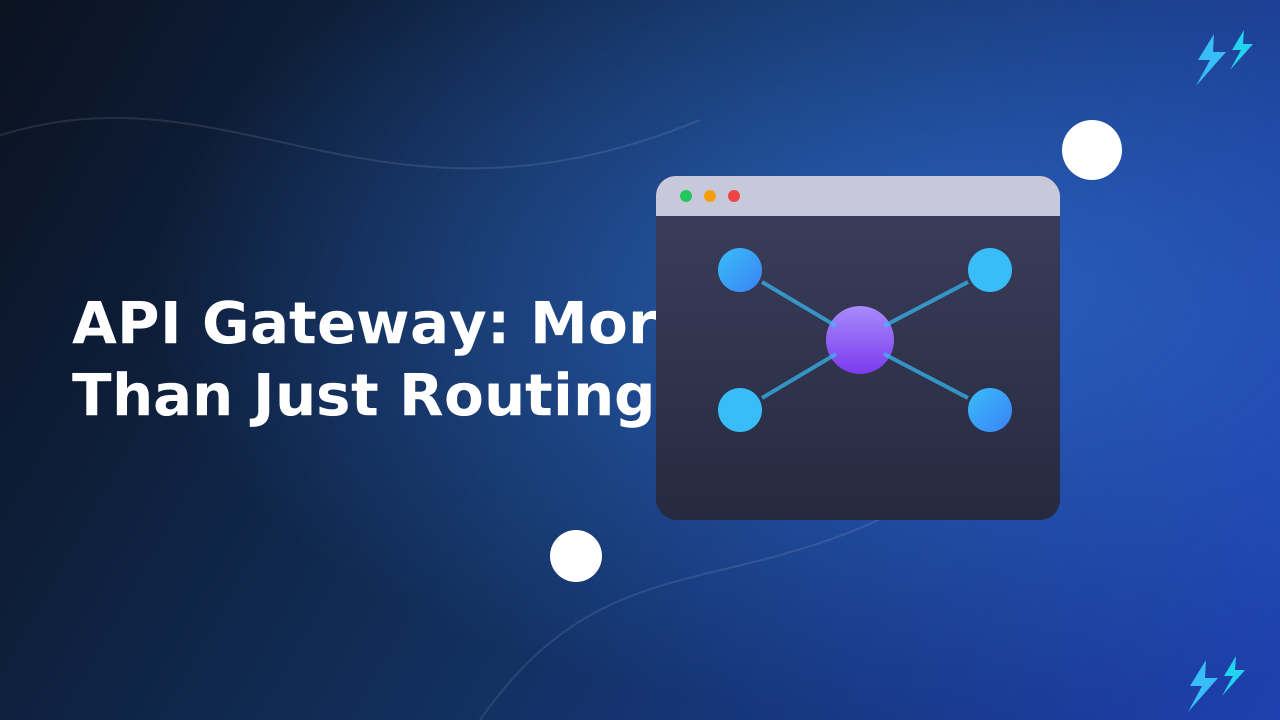
When teams first adopt microservices, the API gateway gets introduced as 'the thing that routes requests to the right service.' That description is accurate and almost completely undersells it. Routing is the least interesting thing a gateway does. Its real value is being the single front door where cross-cutting concerns live, so that dozens of downstream services do not each have to reimplement authentication, rate limiting, and logging.
Why a single front door helps
Without a gateway, every service must independently handle authentication, throttling, TLS, CORS, and request logging. That means duplicated logic, inconsistent behavior, and a large attack surface. A gateway centralizes these concerns at the edge. Clients talk to one endpoint; the gateway enforces policy once and forwards clean, trusted requests to services that can focus purely on business logic.
The responsibilities that matter
| Responsibility | What the gateway does |
|---|---|
| Authentication | Validate tokens or keys before requests reach services |
| Rate limiting | Throttle clients to protect backends from overload |
| Routing | Map paths and versions to the correct service instances |
| Aggregation | Combine several backend calls into one client response |
| Observability | Emit consistent logs, metrics, and traces at the edge |
| Transformation | Adapt protocols and shapes between clients and services |
Authentication belongs at the edge
Verifying identity once at the gateway lets downstream services trust the request context rather than re-authenticating. The gateway validates the credential - often a signed token - and forwards identity to services in a trusted form. This pairs naturally with stateless services, which can then read identity from the request instead of maintaining sessions themselves.
Rate limiting protects the whole system
A single misbehaving or malicious client can overwhelm a backend. The gateway is the natural place to enforce rate limits and quotas because it sees every request before it fans out. Limiting at the edge protects every service behind it at once, and centralizes the policy so limits are consistent rather than reinvented per service.
routes:
  - path: /orders/**
    service: order-service
    filters:
      - name: JwtAuth
      - name: RateLimit
        args: { requestsPerSecond: 20, burst: 40 }
- name: RequestLoggingAggregation and versioning
Gateways can compose multiple backend calls into one client response, sparing mobile and web clients from chatty round trips. They are also where API versioning is often enforced - routing v1 and v2 paths to different implementations, or translating between them - so clients migrate on their own schedule.
The risks of centralization
Centralizing everything at the gateway has a cost. The gateway becomes a critical path: if it is down, everything is down, so it must be highly available. It can also become a bottleneck or a dumping ground for business logic that does not belong there. The discipline is to keep the gateway focused on cross-cutting concerns and resist pushing domain logic into it.
- Keep it highly available - it is a single point of failure by design.
- Keep business logic out of it; the gateway enforces policy, services own behavior.
- Watch its latency budget - every request pays the gateway's overhead.
- Version and test gateway configuration like code, because it governs all traffic.
Conclusion
An API gateway is far more than a router. It is the enforcement point for authentication, rate limiting, aggregation, versioning, and observability - the cross-cutting concerns that would otherwise be duplicated across every service. Treat it as the disciplined front door of your system: centralize policy there, keep domain logic out, and make it resilient, and it will let the services behind it stay small and focused.